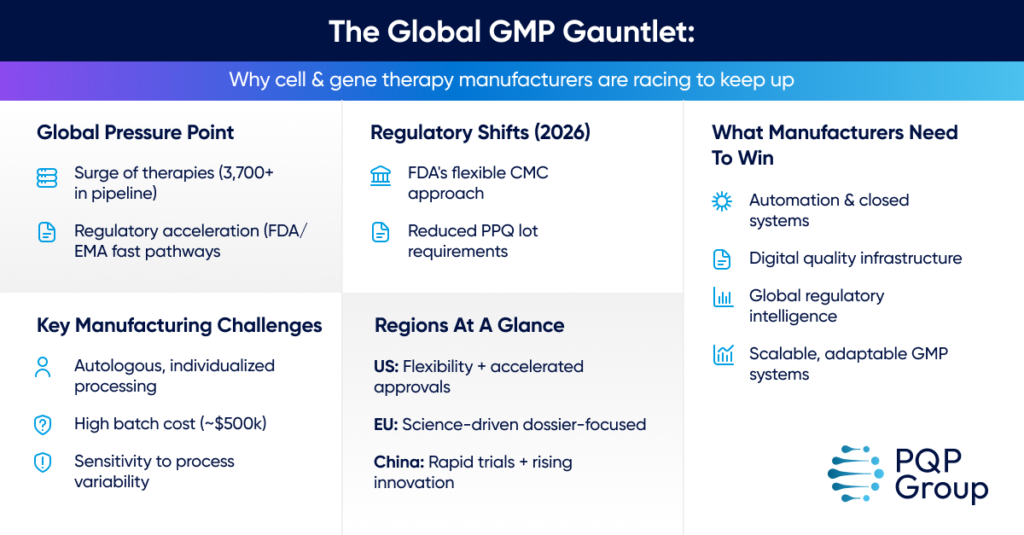
Cell & Gene Therapy has progressed rapidly from scientific innovation to global industrialisation. As pipelines expand and regulatory expectations evolve, manufacturers are finding that the greatest challenge is no longer discovery, but executing consistently under complex GMP requirements. This article examines the key factors driving GMP pressure across advanced therapies.
Cell and Gene Therapy (CGT) has reached a pivotal point. Once defined by scientific feasibility and clinical promise, the sector is now shaped by its ability to manufacture, control, and scale living therapies within demanding regulatory frameworks.
With thousands of therapies in development across oncology, rare disease, and regenerative medicine, the pressure on manufacturers has intensified. Regulatory agencies have demonstrated willingness to accelerate patient access, yet they continue to raise expectations around product understanding, process control, and data robustness. As a result, Good Manufacturing Practice (GMP) has emerged as one of the most decisive factors in whether advanced therapies progress smoothly or stall.
1. Rapid Pipeline Growth and Rising Quality Expectations
Global development activity in CGT has expanded significantly over the past decade, moving from experimental programmes to late‑stage pipelines and commercial launches. Regulatory authorities are approving more advanced therapies than ever before, often under expedited or conditional pathways.
However, faster pathways have not translated into lower quality expectations. On the contrary, regulators increasingly expect manufacturers to demonstrate:
- Clear understanding of critical quality attributes
- Robust control of manufacturing variability
- Meaningful potency assays linked to mechanism of action
- Well‑defined specifications supported by data
- Lifecycle management strategies for manufacturing change
Many regulatory delays are now attributed not to insufficient clinical efficacy, but to gaps in quality development. This reflects a broader industry transition, where the maturity of GMP systems must advance in parallel with scientific progress
2. Manufacturing Complexity as a Structural Challenge
Unlike traditional pharmaceuticals, cell and gene therapies are inherently difficult to manufacture at scale. Many products are living, patient‑specific, or highly sensitive to environmental conditions. This creates operational challenges that standard GMP frameworks were not originally designed to accommodate.
Common sources of complexity include:
- Autologous manufacturing models with one‑patient‑per‑batch production
- Small batch sizes limiting statistical process control
- High operator involvement and manual interventions
- Short shelf lives and time‑critical logistics
- Sensitivity to minor process or material variation
Because these therapies cannot be terminally sterilised, aseptic control must be maintained throughout the process. This places significant emphasis on facility design, closed systems, operator training, and contamination control strategies. As production volumes increase, these factors become increasingly difficult to manage without thoughtful system design.
3. Regulatory Flexibility and the Shift to Lifecycle Thinking
Regulatory authorities have acknowledged that classical GMP models are not always appropriate for advanced therapies, particularly during early development. In response, regulators have adopted more flexible, lifecycle‑based approaches to chemistry, manufacturing, and controls (CMC).
This includes acceptance of phase‑appropriate GMP controls, evolving specifications over development, and alternative approaches to process validation. However, flexibility brings new responsibilities.
Rather than relying on prescriptive rules, manufacturers are now expected to justify their approaches scientifically, demonstrate continual process understanding, and manage change through data‑driven decision‑making. Regulatory discussions increasingly focus on whether a company understands its product and process deeply enough to manage risk, rather than whether it follows a fixed set of precedents.
4. Divergent Global GMP Expectations
As CGT becomes an international industry, manufacturers must navigate regulatory systems that are aligned in intent but diverse in execution.
While there is broad agreement on principles such as risk‑based development and lifecycle management, regional differences remain in how potency, comparability, and quality system maturity are assessed. This creates challenges for companies pursuing global development and commercialisation strategies. Managing these differences often requires parallel quality strategies, region‑specific data packages, and careful coordination of manufacturing changes across markets. For organisations without mature regulatory intelligence and quality governance, this complexity can become a significant barrier to expansion.
5. Infrastructure Growth Without Capability Alignment
In recent years, substantial investment has been made in advanced therapy manufacturing infrastructure, including specialised facilities and contract manufacturing capacity. Yet many sites remain under‑utilised or struggle to move from clinical to commercial readiness.
This reflects a broader capability gap. Physical infrastructure alone does not ensure GMP readiness for CGT. Success depends on:
- Experienced technical leadership
- Modern, adaptable quality systems
- Integrated manufacturing science and data analytics
- Skilled operators trained specifically for ATMP environments
- Clear governance for change management and comparability
Without these elements, increased capacity does not necessarily translate into reliable, scalable manufacturing.
6. Quality as an Enabler of Scale and Speed
Across the industry, a consistent pattern is emerging: quality systems that are designed early and embedded deeply are enabling faster, more predictable development.
Manufacturers that integrate GMP thinking into early process design, assay development, and supply chain planning are often better positioned to manage late‑stage change and regulatory scrutiny. Conversely, organisations that treat GMP as a downstream compliance exercise frequently encounter friction as programmes accelerate.
In this context, quality is no longer a reactive function. It has become a foundational capability that supports speed, scalability, and long‑term product sustainability.
Conclusion
Cell and Gene Therapy manufacturing has entered a phase where execution determines impact. Scientific innovation remains essential, but it is the ability to manufacture complex therapies consistently, compliantly, and at scale that defines success.
As regulatory expectations evolve and global pipelines mature, GMP has become one of the industry’s most demanding and strategic challenges. Navigating this “GMP gauntlet” requires not only technical compliance, but deep process understanding, adaptable quality systems, and an appreciation of how science, regulation, and operations intersect in advanced therapies.